
Activities of Daily Living List: A Complete ADL and IADL Guide
Understand basic ADLs, instrumental tasks, and the different levels of daily assistance.
Read ArticleWhen an aging parent refuses help at home, start by asking what concerns them and offering one specific kind of assistance—not by trying to win an argument about care. If there is no immediate emergency, the goal is a practical next step your parent can help choose.
You may see skipped meals, difficulty getting dressed, or a home that is becoming harder to manage. Your parent may see an adult child questioning their independence. Both perspectives deserve a place in the conversation.
Here is how to approach that conversation, recognize when professional input is needed, and explore support in Wisconsin.
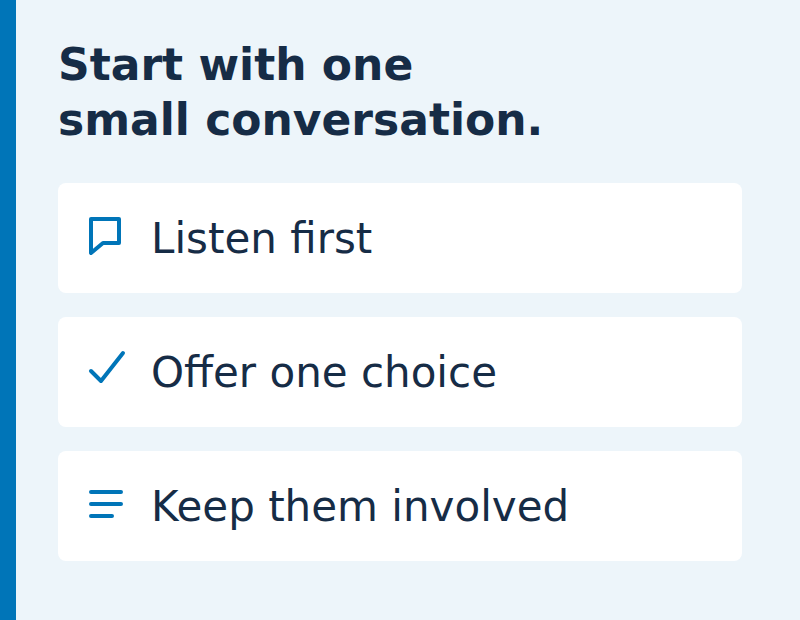
“I don't need help” does not explain what feels uncomfortable. Before suggesting another service, ask:
The answer might be cost, privacy, an unfamiliar person entering the home, or a fear that accepting help means moving out. Do not assume you know the reason.
Listen without immediately correcting their response. You might say, “I understand that having someone in your home feels like a big change.” Acknowledging that concern does not mean ignoring a safety problem.
A long list of problems can make the discussion feel like an accusation. Choose one recent observation and ask an open question.
Instead of “You can't manage here anymore,” try:
“You mentioned that standing long enough to make dinner has become difficult. What would make evenings easier?”
The National Institute on Aging recommends raising concerns without sounding critical and pairing suggestions with practical help.
Distinguish a safety concern from a difference in preferences. A parent who folds laundry differently does not necessarily need assistance. A parent who says dressing is painful deserves a conversation about that difficulty and, where appropriate, a medical evaluation.
“You need a caregiver” starts with your proposed solution. “You want to keep making your own breakfast” starts with your parent's goal.
Ask which activities matter most: staying in familiar surroundings, choosing meals, getting dressed comfortably, or keeping a usual routine. Then discuss help that supports that goal without taking over tasks they can and want to do.
For example, assistance with bathing and dressing may leave someone with more time and energy for the rest of their morning. The appropriate level of help depends on the person's needs and care plan.
If you are unsure which tasks to discuss, our guide to activities of daily living explains the everyday activities involved in personal care.
Avoid presenting a complete schedule as a decision that has already been made. Ask which task your parent would feel most comfortable discussing first.
Possible next steps include:
Be honest about the purpose of any visit. Do not introduce a professional as “just a friend” or arrange a surprise assessment. Ask the provider about actual scheduling, costs, service terms, and availability before suggesting a trial arrangement.
Our Wisconsin personal care assessment guide can help your family prepare questions for an initial conversation.
Difficulty with daily tasks is not something to diagnose during a family disagreement. The National Institute on Aging identifies concerns such as falls, significant weight changes, confusion, and trouble walking as reasons someone may need additional support. It recommends a health care visit when you are worried about physical or mental health.
Offer to help arrange an appointment or attend with your parent's permission. Share specific observations rather than labels such as “stubborn” or “incapable.”
If memory or thinking changes are affecting the conversation, ask a qualified clinician how to approach care decisions. Refusing a service, by itself, is not a diagnosis.
For an immediate medical emergency or immediate danger, call 911. An agency inquiry or a future assessment is not a substitute for emergency help.
You may not reach agreement in one discussion. If there is no immediate danger, ask whether you can return to one specific concern later rather than repeating the same argument every day.
Be clear about your own limits, too:
“I can bring groceries on Saturday, but I can't be here every evening. Can we look together at another way to make dinner easier?”
This is different from threatening to withdraw all support. It gives your parent accurate information about what family members can realistically provide.
With permission, agree on check-ins, useful contact numbers, and who to call if needs change. If you remain concerned about safety or your parent's ability to understand a decision, seek qualified professional guidance rather than assuming family disagreement gives you authority to override them.
Wisconsin's Aging and Disability Resource Centers, or ADRCs, provide unbiased information about local aging and disability resources. They serve older adults, adults with disabilities, and family caregivers regardless of income.
An ADRC can help your family explore options and connect with benefit specialists. Getting information does not establish eligibility for funded services or guarantee that a particular service will be covered.
For day-to-day assistance, ask providers exactly what they can support. Personal care may include help with bathing, dressing, toileting, and other daily activities, according to the individual's care plan. This is different from medical diagnosis, nursing treatment, or therapy.
If your family is exploring personal care in Milwaukee or nearby Southeast Wisconsin communities, call 262-420-4008 to discuss your parent's needs and ask whether Support Plus Personal Care can support them.
Share what your parent wants to keep doing independently, which tasks have become difficult, and what would help them feel comfortable with your caregiver. You do not need to settle every question before making an inquiry.
The next step can be a conversation—not a commitment to give up control.
Understand basic ADLs, instrumental tasks, and the different levels of daily assistance.
Read Article
Prepare questions about daily routines, preferences, and the first service conversation.
Read Article
Compare agencies, caregiver screening, communication, schedules, and available services.
Read ArticleTell us which daily routines need support, and our team can explain the Support Plus services that may fit an authorized care plan.